
Cybersecurity Professional Program
Cybersecurity Professional Program
Build industry-ready skills with practical training, expert guidance and career-focused learning.
Apply Now3 Months
120 Hours
Monday – Friday
Offline / Online
17 Modules
Course Overview
The Cybersecurity Professional Program at Jigsaw TechnoHub is a cybersecurity course with placement in Coimbatore, built for people who want to defend real systems, not just read about them. You learn to protect networks, applications, and data from the threats organizations face every day.
You start with the basics: networking, operating systems, and core security principles. From there, the program moves into ethical hacking, vulnerability assessment, web application, security monitoring, and incident response. Along the way, the SOC Analyst training shows you how a security operations team spots and handles live threats.
Every concept is backed by hands-on labs, simulated attack environments, and real-world projects. This cybersecurity certification course prepares you to find weaknesses, read the signs of an attack, harden systems, and respond when an incident happens.
By the end of the programme, students will:
- Understand cybersecurity principles and security architecture
- Understand computer networks and operating systems
- Identify common cyber threats and vulnerabilities
- Perform basic security assessments
- Analyse network traffic and security events
- Understand ethical hacking methodologies
- Perform vulnerability assessment and penetration testing
- Test web application security
- Apply basic cloud and endpoint security concepts
- Monitor and investigate security incidents
- Understand digital forensics fundamentals
- Use AI tools to support cybersecurity workflows
- Build a professional cybersecurity project portfolio
COURSE MODULES
01 | Introduction to Cybersecurity
Get the big picture of how cyber-attacks happen, who is behind them, and what it takes to keep digital systems and information safe. It also gives you a first look at ethical hacking, the starting point for our Ethical Hacking course.
What You'll Learn
- Introduction to Cybersecurity
- Importance of Information Security
- Cybersecurity vs Information Security
- Cyber Threats and Cyber Attacks
- Common Types of Cyber Attacks
- Malware
- Phishing
- Social Engineering
- Password Attacks
- Data Breaches
- Insider Threats
- Cybersecurity Roles and Career Paths
- Cybersecurity Ethics
- Introduction to Ethical Hacking
02| Networking Fundamentals for Cybersecurity
Every attack travels across a network, so you need to know how networks work before you can defend one. This module builds the networking foundation that SOC Analyst training depends on, so you can analyze and secure network environments with confidence.
What You'll Learn
- Computer Network Fundamentals
- LAN, WAN and Internet
- OSI Model
- TCP/IP Model
- IP Addresses
- IPv4 and IPv6
- MAC Addresses
- Ports and Protocols
- TCP and UDP
- DNS
- DHCP
- HTTP and HTTPS
- FTP and SSH
- Routers and Switches
- Firewalls
- VPN Fundamentals
- Network Security Basics
03| Operating Systems & System Security
Learn how Windows and Linux work behind the scenes, and how to lock them down against the threats that target them every data.
What You'll Learn
- Operating System Fundamentals
- Windows Fundamentals
- Linux Fundamentals
- Linux Command Line
- Files and Directories
- Users and Permissions
- Processes and Services
- System Configuration
- System Logs
- Windows Security Basics
- Linux Security Basics
- User Account Management
- Access Control
- System Hardening Fundamentals
04| Cyber Threats, Vulnerabilities & Security Controls
See how vulnerabilities come about, how attackers exploit them, and hich controls stop them before real damage is done.
What You'll Learn
- Cyber Threat Landscape
- Threat Actors
- Attack Vectors
- Vulnerabilities
- Exploits
- Risk and Impact
- Threat Assessment
- Vulnerability Assessment Fundamentals
- Security Controls
- Preventive Controls
- Detective Controls
- Corrective Controls
- Authentication
- Authorization
- Multi-Factor Authentication
- Principle of Least Privilege
- Security Policies
05|Beginner Cybersecurity Labs & Project
Put what you’ve learned into practice with hands-on exercises in controlled lab environments. These labs are the first step toward the job-ready skills that make this cybersecurity course with placement worth your time.
Projects
- Network Security Analysis
- Password Security Assessment
- Phishing Awareness Analysis
- Linux Security Configuration
- Basic Vulnerability Assessment
Students will prepare:
- Security assessment reports
- Vulnerability reports
- Risk observations
- Security recommendations
06 | Ethical Hacking Fundamentals
Learn to think like an attacker so you can stop one. This module of our Ethical Hacking course walks you through the full methodology, from reconnaissance and scanning to reporting your findings, all within clear legal and ethical boundaries
What You'll Learn
- Introduction to Ethical Hacking
- Ethical Hacking Methodology
- Reconnaissance
- Information Gathering
- Passive and Active Reconnaissance
- Scanning
- Enumeration
- Vulnerability Identification
- Exploitation Fundamentals
- Privilege Escalation Concepts
- Maintaining Security Awareness
- Reporting Security Findings
- Rules of Engagement
- Legal and Ethical Considerations
07| Vulnerability Assessment & Penetration Testing
Find out how security professionals uncover, rate, and validate weaknesses in controlled environments. You work with industry tools like Nmap, Wireshark, OpenVAS / Greenbone and Kali Linux, and learn to turn your findings into clear security recommendations.
What You'll Learn
- Vulnerability Assessment
- Penetration Testing Fundamentals
- Vulnerability Scanning
- Security Assessment Methodology
- Risk Rating
- CVE Fundamentals
- CVSS Fundamentals
- Network Vulnerability Assessment
- System Vulnerability Assessment
- Vulnerability Validation
- False Positives
- Security Recommendations
- Penetration Testing Reports
Tools Introduced
- Nmap
- Wireshark
- OpenVAS / Greenbone
- Kali Linux
08| Web Application Security
Web applications are one of the most common targets for attackers. Learn how they work, where they break, how to test them, and how to test them using the OWASP Top10 as your guide. You get hands-on with Burp Suite, OWASP ZAP, and Browser Developer Tools.
.What You'll Learn
- Web Application Architecture
- HTTP Requests and Responses
- Cookies and Sessions
- Authentication and Authorization
- Input Validation
- Access Control
- Common Web Vulnerabilities
- SQL Injection Concepts
- Cross-Site Scripting
- Cross-Site Request Forgery
- Security Misconfiguration
- Broken Authentication
- API Security Fundamentals
- OWASP Top 10
- Web Security Testing Methodology
Tools Introduced
- Burp Suite
- OWASP ZAP
- Browser Developer Tools
09| Network Security & Traffic Analysis
Learn how firewalls, IDS and IPS, VPNs and secure network design protect organizations, and how to read network traffic to spot suspicious activity. You build practical packet analysis skills with Wireshark, a core part of SOC Analyst training.
What You'll Learn
- Network Security Architecture
- Firewalls
- IDS and IPS
- Network Segmentation
- VPN
- Proxy Servers
- Secure Network Design
- Network Monitoring
- Packet Analysis
- Traffic Analysis
- Suspicious Traffic Identification
- Network Attacks
- DNS Security
- Wireless Network Security
- Wireshark
10| Security Monitoring & SIEM Fundamentals
Step inside a Security Operations Center and learn how analysts detect threats. You work with logs, alerts, and indicators of compromise, then use SIEM tools like Splunk/ELK to correlate events and investigate incidents. This is the heart of our SOC Analyst training.
What You'll Learn
- Introduction to Security Operations
- Security Monitoring
- Security Events
- Log Management
- Windows Logs
- Linux Logs
- Network Logs
- Security Alerts
- Indicators of Compromise
- Threat Detection
- SIEM Fundamentals
- Log Correlation
- Alert Investigation
- Security Dashboards
- Introduction to Splunk / ELK
11| Intermediate Cybersecurity Projects
Bring networking, vulnerability assessment, web security, and monitoring together in real projects. You build assessments, reports, and a security monitoring dashboard that become part of your portfolio, strengthening your case in this cybersecurity course with placement.
Projects
- Network Vulnerability Assessment
- Web Application Security Assessment
- Network Traffic Analysis
- Security Monitoring Dashboard
- Vulnerability Assessment Report
12 | Advanced Ethical Hacking & Penetration Testing
Go deeper into professional penetration testing in authorized lab environments. Practice enumeration, exploitation concepts, attack path analysis and evidence collection, then present your findings in a professional penetration testing report.
What You'll Learn
- Advanced Reconnaissance
- Network Enumeration
- Service Enumeration
- Vulnerability Analysis
- Exploitation Concepts
- Privilege Escalation Concepts
- Password Security Assessment
- Post-Exploitation Concepts
- Security Assessment Methodology
- Attack Path Analysis
- Evidence Collection
- Risk Analysis
- Professional Penetration Testing Reports
13| Active Directory & Enterprise Security
Learn how enterprise Windows environments are secured and where Active Directory is most often attacked. Understand common security risks and how to defend against them.
What You'll Learn
- Active Directory Fundamentals
- Domains and Domain Controllers
- Users and Groups
- Group Policies
- Authentication
- Kerberos Fundamentals
- Access Control
- Privileged Accounts
- Active Directory Security
- Identity and Access Management
- Enterprise Security Controls
- Security Monitoring
- Common Active Directory Attack Concepts
- Defensive Security Practices
14| Digital Forensics & Incident Response
Learn how security teams investigate incidents and respond to compromises, from identifying an attack and preserving evidence to containment, recovery, and post-incident review. This module builds on your SOC Analyst training with real investigation skills.
What You'll Learn
- Introduction to Digital Forensics
- Incident Response Lifecycle
- Incident Identification
- Evidence Collection
- Evidence Preservation
- Log Analysis
- File System Analysis
- Malware Incident Investigation
- Network Incident Investigation
- Indicators of Compromise
- Timeline Analysis
- Incident Documentation
- Containment
- Eradication
- Recovery
- Post-Incident Analysis
15| Cloud & Endpoint Security
Learn how to secure cloud environments, devices, and user identities in modern organizations. Cover access control, data protection, endpoint protection, and security monitoring.
What You'll Learn
- Introduction to Cloud Security
- Cloud Security Concepts
- Shared Responsibility Model
- Identity and Access Management
- Cloud Authentication
- Access Policies
- Data Protection
- Cloud Network Security
- Endpoint Security
- Endpoint Protection
- Device Security
- Security Configuration
- Vulnerability Management
- Security Monitoring
- Cloud Security Best Practices
16| AI in Cybersecurity & Security Automation
Learn how AI and automation help cybersecurity professionals work faster and smarter. Use them to support threat analysis, security monitoring, investigation, and documentation.
What You'll Learn
- Introduction to AI in Cybersecurity
- Generative AI for Security Professionals
- AI-Assisted Threat Analysis
- AI-Assisted Log Analysis
- AI-Powered Security Monitoring
- AI-Assisted Incident Investigation
- AI-Assisted Vulnerability Analysis
- Security Report Generation
- Threat Intelligence with AI
- Prompt Engineering for Cybersecurity
- Automating Security Workflows
- AI-Assisted Security Documentation
- Limitations of AI in Cybersecurity
- Responsible Use of AI
17| Cybersecurity Capstone Project & Career Preparation
Bring everything together in an end-to-end cybersecurity project that proves your skills. Build a portfolio that supports your cybersecurity course with placement and gets you ready for interviews.
Capstone Project
Students will work through:
Information Gathering → Threat Identification → Vulnerability Assessment → Security Testing → Network Analysis → Web Security Assessment → Log Analysis → Incident Investigation → Risk Assessment → Security Recommendations → Final Security Report
Capstone Project Process
Business Problem → Data Collection → Data Cleaning → SQL Analysis → Exploratory Analysis → KPI Development → Power BI Dashboard → AI-Assisted Insights → Predictive Analysis → Business Recommendations → Final Presentation
What Students Will Create
- Security Assessment Plan
- Network Analysis Report
- Vulnerability Assessment Report
- Web Security Assessment
- Security Incident Report
- Risk Assessment
- Security Recommendations
- Final Cybersecurity Report
Software & Tools Covered
Throughout the Professional Program, students will gain practical experience with:
- Kali Linux
- Linux
- Windows
- Nmap
- Wireshark
- Burp Suite
- OWASP ZAP
- OpenVAS / Greenbone
- Metasploit – Introduction
- Splunk – Introduction
- ELK Stack – Introduction
- Git & GitHub
- VirtualBox / VMware
- Python – Security Automation Basics
- SQL
- PowerShell – Introduction
- Bash
- ChatGPT
- Google Gemini
- AI-powered cybersecurity tools
- Generative AI tools
Career Opportunities
After completing the Professional Program, learners can pursue roles such as:
- Cybersecurity Analyst
- Security Analyst
- SOC Analyst
- Junior Security Engineer
- Information Security Analyst
- Cybersecurity Consultant – Entry Level
- Vulnerability Assessment Analyst
- Penetration Testing Associate
- Ethical Hacking Associate
- Network Security Analyst
- Application Security Tester
- Incident Response Analyst – Entry Level
- Digital Forensics Analyst – Entry Level
- Cloud Security Associate
- Security Operations Associate
Enquire Now
Ready to build your IT career? Learn AI-powered software courses at Jigsaw through practical projects, real-world datasets and career-focused training.
Placements
Simple steps, Limitless Possibilities

Joseph Price
Data Science

Paul Shajan
Digital Marketing

Thomas
Digital Marketing
Course Cetificate
Certificate
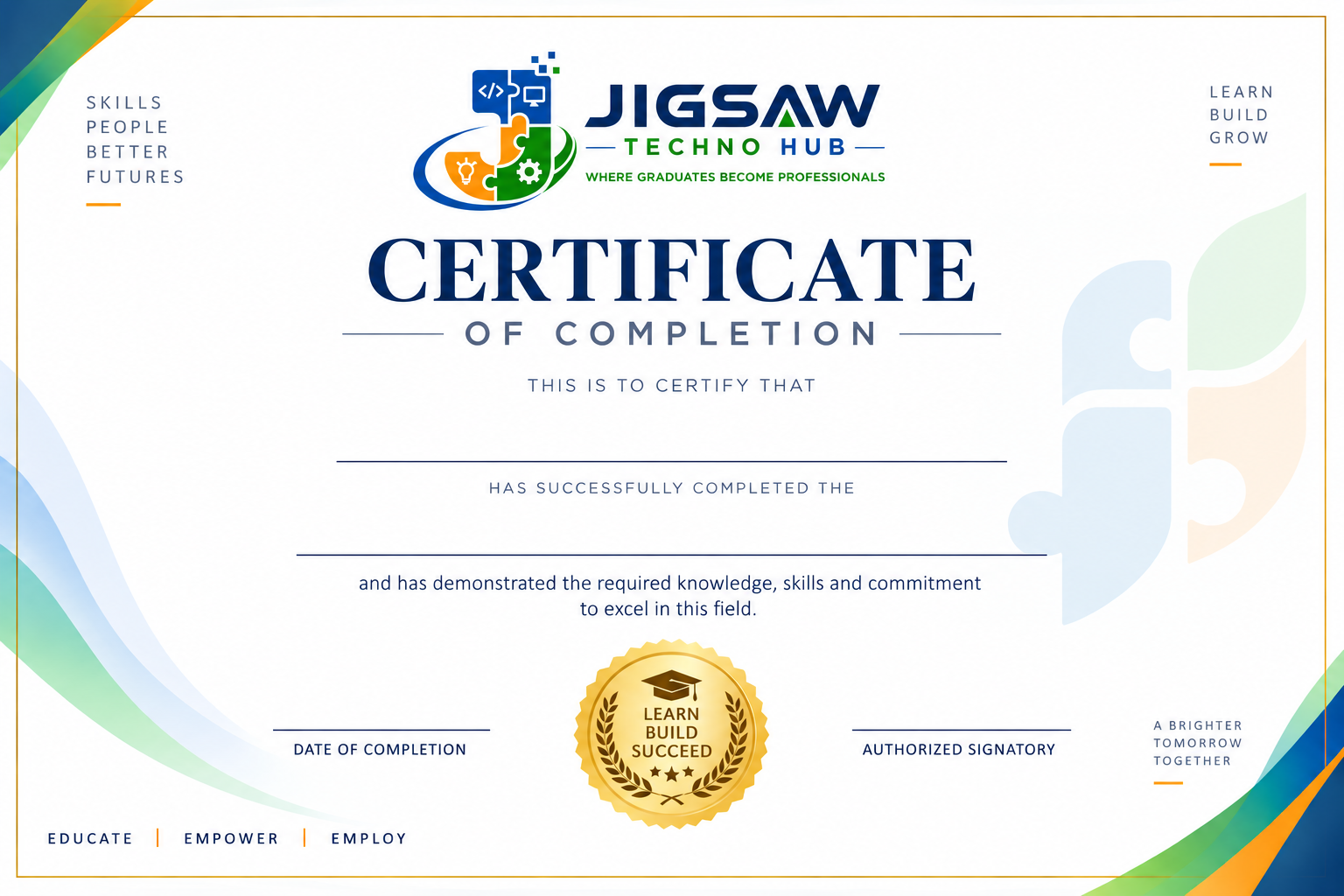
On completing the Cybersecurity Professional Program at Jigsaw TechnoHub, you earn a cybersecurity certification that shows employers you can do the work, not just talk about it. This cybersecurity certification course covers networking, operating systems, ethical hacking, vulnerability assessment, security monitoring and incident response, all backed by hands-on labs and real projects.
- Work with networks, operating systems and core security concepts
- Identify common cyber threats and vulnerabilities
- Perform vulnerability assessments and penetration tests
- Test web applications for security weaknesses
- Monitor and analyze security events with SOC Analyst training
- Investigate and respond to security incidents
- Apply ethical hacking methodologies from our Ethical Hacking course
- Build a project portfolio ready for placement
Ready to Build Your Future?
Your journey from graduate to professional starts here. Join Jigsaw TechnoHub and gain the skills, confidence, and industry exposure needed to succeed in today's competitive job market.